Imagine you are organizing a competition and need to select a winner or multiple winners in a completely random manner. This process can be easily managed on the platform by using specific features such as the wait and limit nodes.
When you identify the eligible customers that should enter the competition draw, you can use a wait node with a random range and a limit node to randomize the customers' orders and pass only one or multiple winners to receive further combinations. This guide is aimed at picking the winners using random factors, not at building the campaign itself.
Example of flow
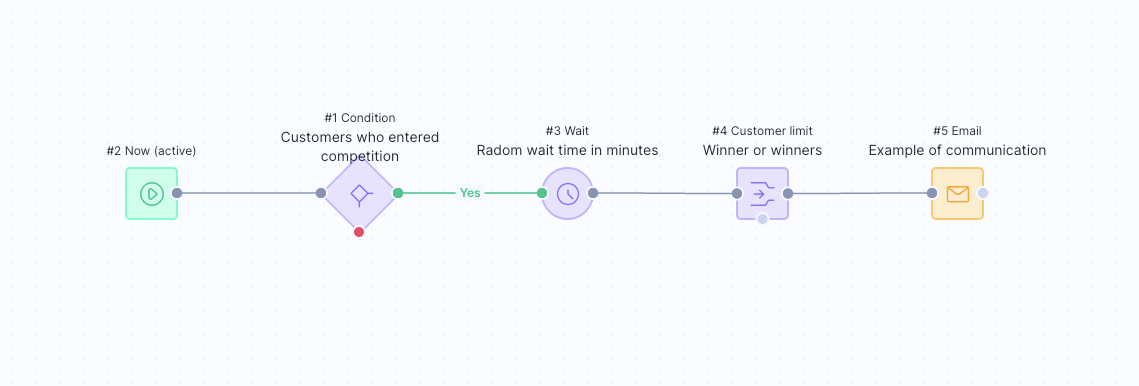
How to randomize the order of customers
When you select a group of people who entered a competition, for example, using a condition node with a specified customer filter, you can randomize the order of customer profiles inside the scenario flow by using a random wait node.
You can use Jinja code {{ range(0,180) | random }} to assign a random number of minutes to the profiles for how much they will wait. This approach ensures that each of the profiles will be assigned a unique wait time. As a result, the sequence in which the customers progress through the flow will be randomized, preventing any predictable or fixed order. Essentially, the first person to enter the flow won’t be the first to exit. You can increase the range so the random factor is even stronger.
How to select one or multiple winners
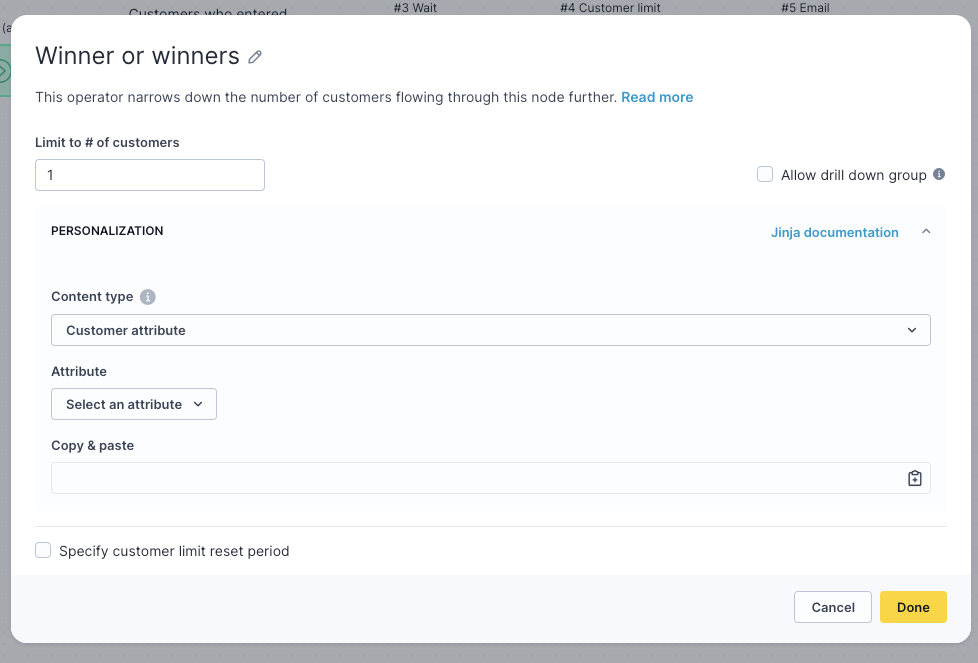
Once the wait node randomizes the flow, you can use the limit node to select either one or multiple winners, as shown in the example below. You can set the limit node based on your specific use case.
The limit node will ensure that from the randomized flow, only one or more customer profiles will enter the next stage of the campaign, for example, email.
Conclusion
This solution will help you randomize the flow and pick only winners from already predefined customer profiles.
Note that using an extensive range for the wait node will mean that some profiles can wait a few hours, even though the winner has already received the communication. Select values in the wait node and limit node per your specific needs.
This universal solution can be used for any scenario-based communication. The number of winners chosen with the limit node or the size of the wait node range is unlimited.